In his director’s note, Titus Andronicus director Brian Hensley describes his production as a “chilling commentary on the systems of power that persist today”. It’s true that the broad concept overseeing The Stage Austin’s current production of Shakespeare’s bloody tragedy is something like “there are parallels between Titus and the current American political and cultural landscape“. It’s a timely idea, and it’s a bold statement for a bold script, but unfortunately, what happens on stage in this Titus doesn’t live up to its written promises.
In staging Titus, Hensley states that he drew theatrical inspiration from ancient Greek Tragedy. This mostly appears in the form of masks worn by some characters. Given that ancient Greek theatre liked to leave violence off-stage, it’s then interesting that the second source of inspo Hensley claims is the defunct shock-horror Theatre du Grand-Guignol. And boy does that inspiration show; there’s graphic violence throughout (including moments other productions often cut), bloody squibs, prop organs, severed heads, and audience splash zones. The traditions Hensley cites are two polar opposite methods of making theatre, and in an abstract are ripe for a staging full of tension in contradiction and high stylization. But in practice here, it’s never clear what G.T. and G.-G. are even doing in the same show. And that’s the most pressing problem with Hensley’s Titus: almost all of its ideas fizzle out with no follow-through of execution or completion of thought, to the point that the entire play becomes unfocused and confused.
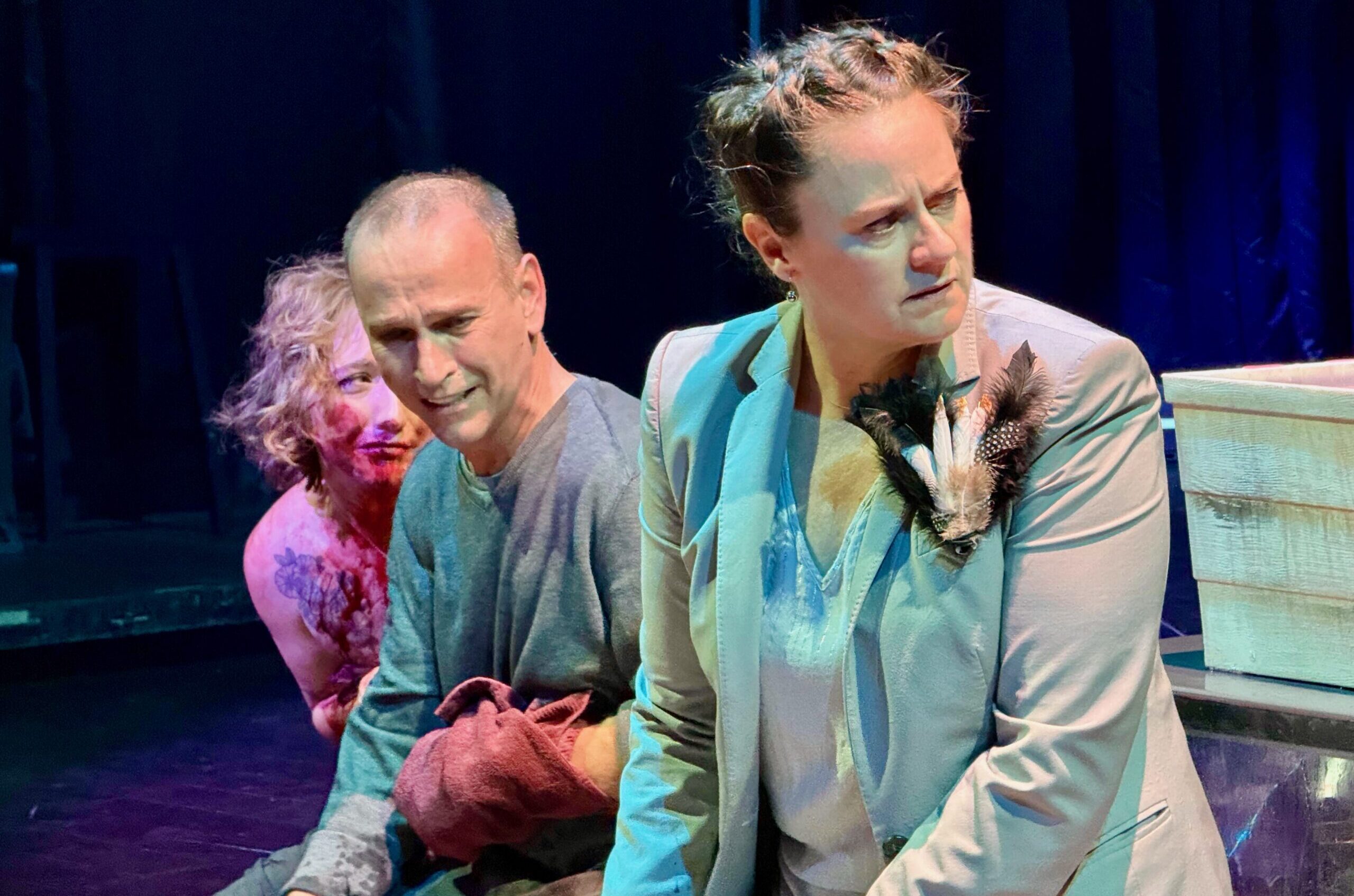
Hensley and his cast can’t seem to decide what genre of of show they’re doing. In fact, sometimes even actors in the same scene can’t seem to agree. For example, in Act 3, Titus (Timothy McKinney, one of the few standout performances) delivers a heartfelt monologue about grief over two of his sons, only to be interrupted by a goofy, cliche a-hem from Lucius (Mateo Barrera), who clearly thinks he’s walked into something funny.
Not just comedy, but intensity of the horror throughout is inconsistent. All moments of actual violence are intense, but the moments often come as a surprise given the unwieldy blocking and lack of suspense in the scenes immediately leading up to them. The chase before the rape of Lavinia (Samantha Plumb) is staged with such lackluster physicality that it strips Chiron (Achilles Patino-Sesmas) and Demetrius (Jess Buie) of any intimidation over Lavinia – until the fight choreographer (Aaron D. Alexander) must have taken over the scene, and the Goths are suddenly able to wrestle Lavinia to the ground, cut out her tongue, and show it off it to the audience.
Visually, even, the play doesn’t quite make sense. Costumes (Ashley Batista) seem to have been put together because they are grey, with little to no regard to storytelling, character dynamics, or internal consistency (or fit issues, in a number of cases). Is this cautionary tale post-apocalyptic? Post-modern? Is it “everywhere and nowhere”, as Shakespeare companies love to claim? Yes, they’re all modern garments, but no one costume speaks to another stylistically. Some Romans wear sandals, but not all of them. One of Titus’s sons wears a suit jacket, but another son wears a thin cardigan. Minor characters are consigned to wear medical scrubs. It’s suggested that Goth Tamora’s colors are black and gold, and the Andronci’s are grey and silver (and Saturninus’s colors are…?); but even that isn’t executed consistently, and the result is confusion rather than coordination.
The set design (also Brian Hensley) is somewhat more cohesive, if not practical. (A major plot point of Act 2 involves at least three people falling into a pit in the woods, but the pit these actors must “fall” into is so shallow it’s hard to take their predicament seriously. So should we take it seriously or not?) A literal fountain of blood, cooler-sized and gurgling, dominates the front and center of the space. Along the back wall a set of wide, neon-backlit frosted glass doors open into a foggy darkness. Sometimes, these doors symbolize a character’s death – but not every character who dies goes into the neon tomb, and sometimes people come out of it who are very much still alive. The blood fountain is clearly a key priority for the show and the functioning of the advertised Splash Zones, but its placement hobbles the staging, forcing every scene to feature awkward crosses around it.
There are, as I said, a few standout performances in the cast. As Titus’s brother Marcus, Jacquelyn Lies radiates compassion and sympathy to Plumb’s mutilated, pitiable Lavinia. Aaron D. Alexander elevates and dignifies every scene he is in as Aaron the Moor. Michael Osborn and Austin Lytle spend most of the second half of the show playing minor characters, and maybe have some of the most fun on stage. But it’s clear these performances come because these actors are talented and have put in work on a difficult, intense script, rather than because of – or maybe in spite of – the direction of their work.
The broad concept that The Stage’s Titus is premised on isn’t a totally wrong read of the show; it’s also not a particularly unique one. Every generation at every age has seen their political situation paralleled in a Julius Caesar or a Richard III or a Coriolanus or a Titus Andronicus. But this Titus somehow does even less than just say something that’s been said before. It never sharpens into any specificity, and therefore says nothing, about either itself or our modern-day situation. Mostly, it says quite a lot about stage blood.
Titus Andronicus runs at The Stage Austin through January 25, 2026. For tickets and more information, visit The Stage Austin online.


Leave a Reply
You must be logged in to post a comment.