
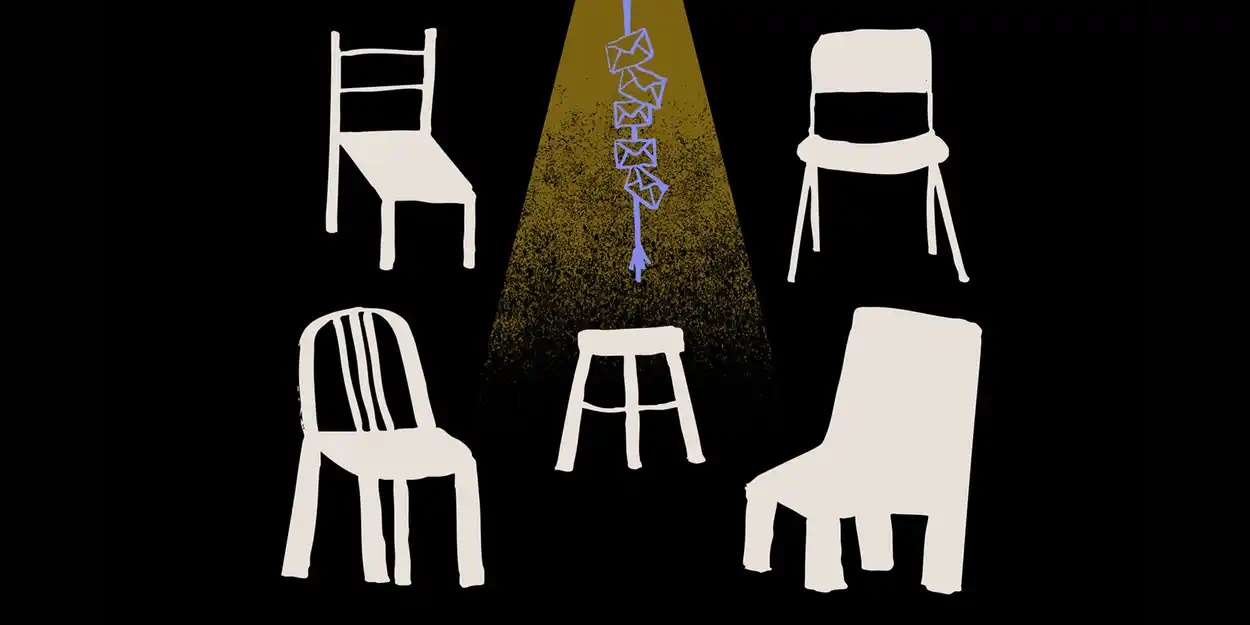
YOKE is a new piece of devised theater directed by Rebecca Greaves, and written by Roy Lazorwitz and Meret Slover. It is a short piece (50 minutes, no intermission) that, according to its materials, is “guided by the theme of sonder (the awareness that everyone carries a rich inner life).” The piece is a character study of five strangers in a mysterious wellness retreat/group therapy session. Each enters the room with their stated reason to be there – my new job requires it, my daughter suggested it, a shaman in San Diego told me about it – but they’re slowly forced to come to terms with the real reasons each of them is looking for healing.
(If you’re a chronically online millennial like myself and wondering didn’t I see that word on tumblr a lot it’s because you have! Sonder is a word that has existed for maybe 15 years, having been coined as part of The Dictionary of Obscure Sorrows in the early 2010s and then passed around on the internet enough that it became, I guess, a “real” word for an experience that didn’t previously have a name.)
The cast mesh so well together, I’d love to have been a fly on the wall during their devising rehearsals. Joe Kelley’s Craig is quiet, steady, helpful, cradling a secret so close to his heart it hurts. As rich-girl-turned-hippie River, Chrissy Pace flutters around the stage barefoot, bracelets jangling as she cleanses the air and spritzes her costars with essential oils (perhaps the same way she wishes to simply spritz clean her own past? Hmmm!). Kahla Brown is a laced-up, logical tech executive with a purse full of post-it notes named Helena; she’s one of the most fun ones to watch, as the armor of her pulled-back hair and business casual look fall apart in the face of emotional vulnerability. There’s harried, hurried mom Yasmine, played by Stephanie Salama, who apologizes before anyone can even ask, silently resigns herself to leftovers, and can’t stop laughter from bubbling up when she admits her own secret like a piece of gossip. Julius Alums is dynamic and hilarious as Karaoke King Kendrick; his preferred ways of deflecting emotional questions are joking and snacking, and he energizes what might otherwise have become a weepy, awkward weekend.
The sondering that happens in YOKE isn’t a soft, slowly rising feeling or a profound moment of enlightenment; it’s loud, chaotic, inescapable. Sonder is thrust upon ’em. Characters only become aware of another’s inner life because that inner life is forced out, somewhat traumatically, through a series of odd group therapy exercises. When one person pushes back and refuses to disclose their secrets, the rest of the group descends on them, begging and bullying until they’re worn down and weeping. River chastises Helena for not doing the work when she won’t engage with an exercise the right way, as if the work can be measured by boundaries broken. It raises questions for the audience: Does the awareness of someone’s inner life also entitle us to the intimate details of that inner life? Does revealing one’s own inner life justify interrogation of your neighbor’s? If we must be, as the play’s title implies, yoked together in this thing we call life – must we divulge our most inner, most secret parts, just so that others can see us fully? Must sondering and yoking always be violent and coerced and tit-for-tat?
And if sondering and yoking together are going to be so visceral and guttural in their words, I wish they also translated (more) to the actors’ physicality. There’s a steady stream of expressionist movement throughout YOKE, but it almost always happens on its own, broken apart from conversation, rather than during a scene. In these dance breaks, the dialogue ends, and actors meander through the space, floating and curling around themselves, but the movements don’t quite express anything by themselves. There’s a moment near the emotional climax of the work where a character crawls on his hands and knees while speaking and it feels animalistic and wild and I wanted to scream, yes, keep doing THAT; when words reach their emotional height, so should body movement. Get even weirder! Go nuts! Don’t get me wrong; love th inclusion of tany movement sequences! I just always want more.
The team effort behind YOKE is plainly evident, which is half the fun – and point – of devised theater. It’s a thoughtful, interesting piece, much smoother around the edges than many new works. I didn’t leave the theater wondering about the rich inner life of my stranger neighbors, but I did leave thinking a lot about making theater and movement and art, and a piece of art that makes me want to leap on stage myself is always a kind of gift.
YOKE ran at The Stage Austin from February 26 – March 8, 2026. For more information, visit Dirty Gold Theatre online or read the YOKE program here.
Leave a Reply
You must be logged in to post a comment.