
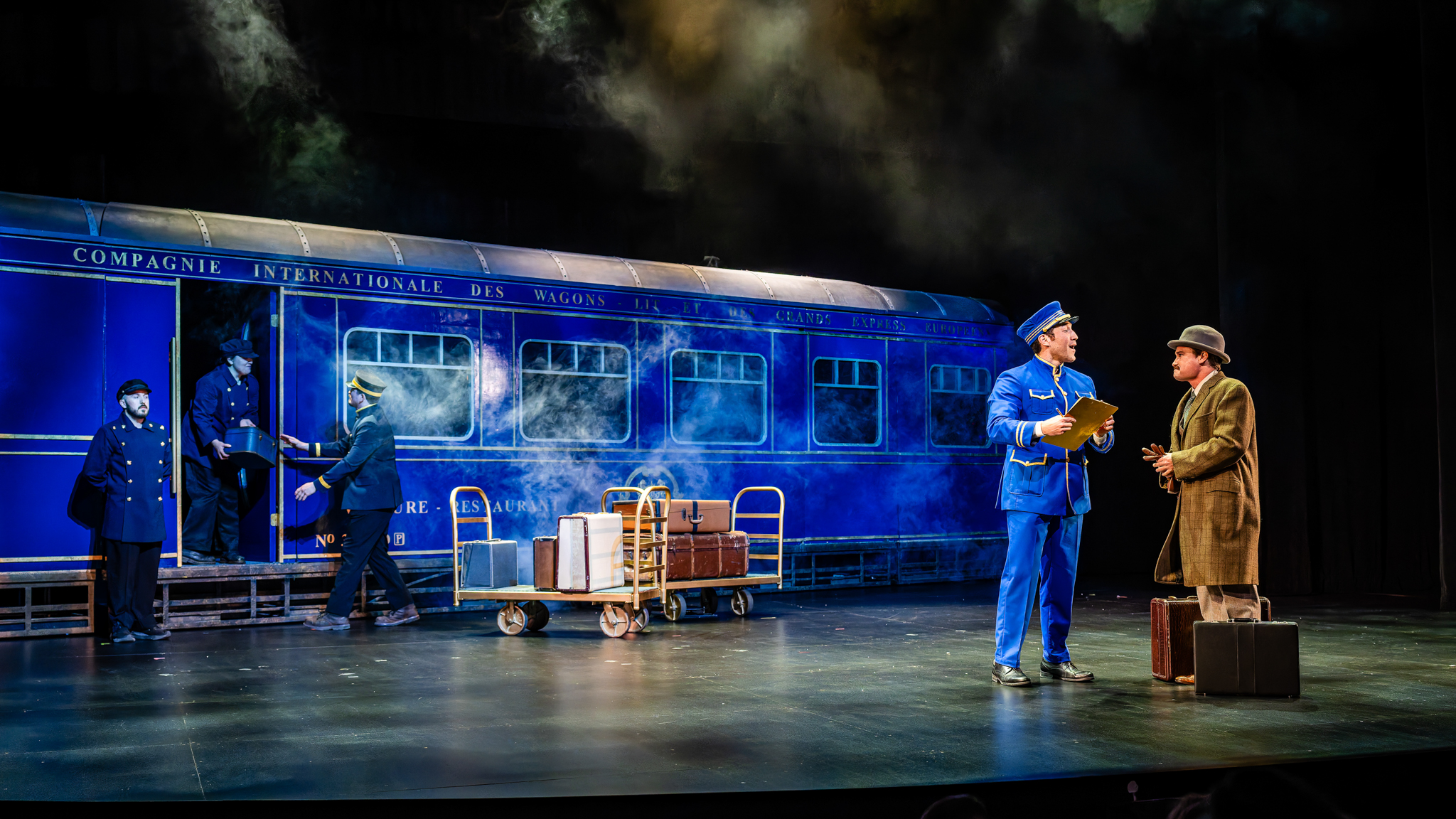
Murder! Intrigue! Trains! The ZACH’s current production of Agatha Christie’s Murder on the Orient Express, directed by Jenny Lavery and written by Ken Ludwig, is a delicious feast for the eyes. The show features beautiful 1930s costumes, an impressive set, and a cast full of big personalities with big feelings to match. The main action is a fun, suspenseful piece of theater – sandwiched with a beginning and end that don’t quite match the tone of the rest. Still, despite the first and last few minutes, Murder impeccably dressed and titteringly funny; plus, it’s a showcase of technical talents, as ZACH shows always are.
From the start, I was not hugely impressed by the pacing of Ken Ludwig’s script. It’s a good half hour into the show before the train even takes off! First there’s a short film to give backstory – the kidnapping and murder of Daisy Buchanan, which may have much to do with the new mystery at hand – then a monologue introduction by Poirot (Steven Pounders, whose mustache, I believe, is real!), then a scene to meet each character individually, and then finally the train starts its journey.
The second act begins with much more energy and immediacy than the first, and it’s then that the show really hits its stride. Jokes get more ridiculous, characters get bigger, stakes get higher, and the foolproof plan to get away with murder begins to look not-so-foolproof. Even though I had seen the movie and mostly remembered the solution, many moments had me gasping in surprise.
Murder is of course a Hercule Poirot story, but it’s a great ensemble piece as well; some characters are goofier than others, some more forthcoming, and some more reticent, but all hold their own throughout. I particularly enjoyed performances from gorgeous and silky smooth Charlene Hong White as Mary Debenham, running away with Colonel Arbuthnot (Scott Shipman), boisterous and joyful Olivia Dawson as Helen Hubbard, determined to charm her way into everyone’s hearts, and Sarita Ocón as Countess Andrenyi, who holds the steadiest head on the train besides Poirot. Really, the only characterization I was not a fan of was Abigail Storm’s Greta Ohlsson; she’s cute and funny, but comes across as “theatre kid playing an awkward girl” rather than actually shy and awkward. But everyone is dressed impeccably: Monica Pasut Gibson’s costumes float and sparkly richly under the stage lights.
And truly, the real star of the show is the gigantic rotating train car set piece (designed by Paul Tate Depot II) on which all of the action takes place. The outside of the train is impressive, but then the car spins to reveal sleeping berths, a dining car, a lounge, a radio operator’s office – “How many sides does this thing have?” I whispered in awe to my friend. Meanwhile, the rest of the stage remains dark; as the car pulls back to make another rotation it begins to resembles a massive ship floating alone in the dark water, unmoored, stranded, helpless, frozen – an image that underlines the isolation of the train and its possibly-murderous passengers. It was disappointing only that this impressive piece of theater magic was surrounded by screens. Regular readers will know I’m never a fan of Screens On Stage (if I wanted to watch a movie, I’d be at the AMC with my seat reclined). In Murder, a thin strip of screen closed the gap between the top of the train and the top of the proscenium. Even though some of its uses were useful (to show a close up of a clue) or funny (for a series of flashbacks as Poirot reveals his discoveries), I really didn’t like the way the entire show started with a filmed backstory. This opening scene is part of Ludwig’s script, but I believe showing it on a screen is an adaptation by Lavery. One just wonders why the backstory of Daisy Armstrong’s kidnapping and murder couldn’t have been worked into the script in a more clever way. It also means the show starts on a fairly dark note. That darkness is quickly replaced by the silliness of the characters, only to then be brought back in the final scene, when Poirot confronts the killers and is himself confronted with a moral predicament. Should we or should we not be laughing at murder? Monsieur Poirot is confused and haunted, and so, it seems, are we.
Murder on the Orient Express plays at the Topfer Theater at the ZACH through March 1, 2026. For tickets and more information, visit ZACH online.
Leave a Reply
You must be logged in to post a comment.